The model proposes; IaCGenius decides what is true
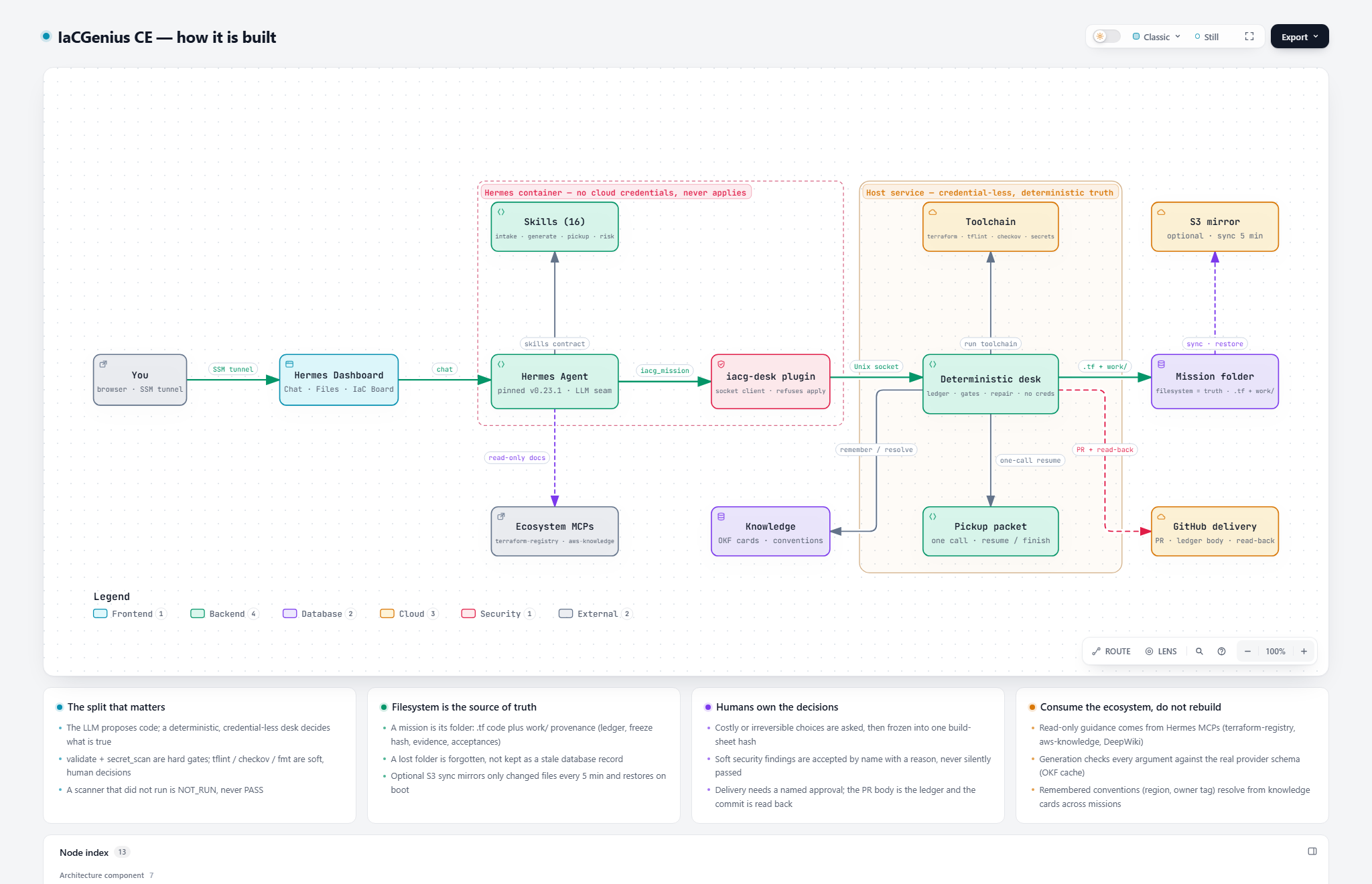
The LLM writes the code, but a small credential-less service owns the decision ledger, runs the real validators, and keeps the evidence. No model output is trusted as a validation result.
Community Edition · Free & open source
IaCGenius Community Edition is our free, open-source product. It writes the Terraform (or OpenTofu), runs the real validators over it, fixes what it can within a fixed budget, and hands you a pull request whose body is the decision ledger. It runs on Hermes Agent. Everything on this page is captured from a live installation.
Most code generators ask you to trust the model. IaCGenius splits the work so you do not have to: the model proposes, a deterministic service proves, and you decide. It is a product you run yourself — not a SaaS, and not a substitute for reviewing the diff.
The LLM writes the code, but a small credential-less service owns the decision ledger, runs the real validators, and keeps the evidence. No model output is trusted as a validation result.
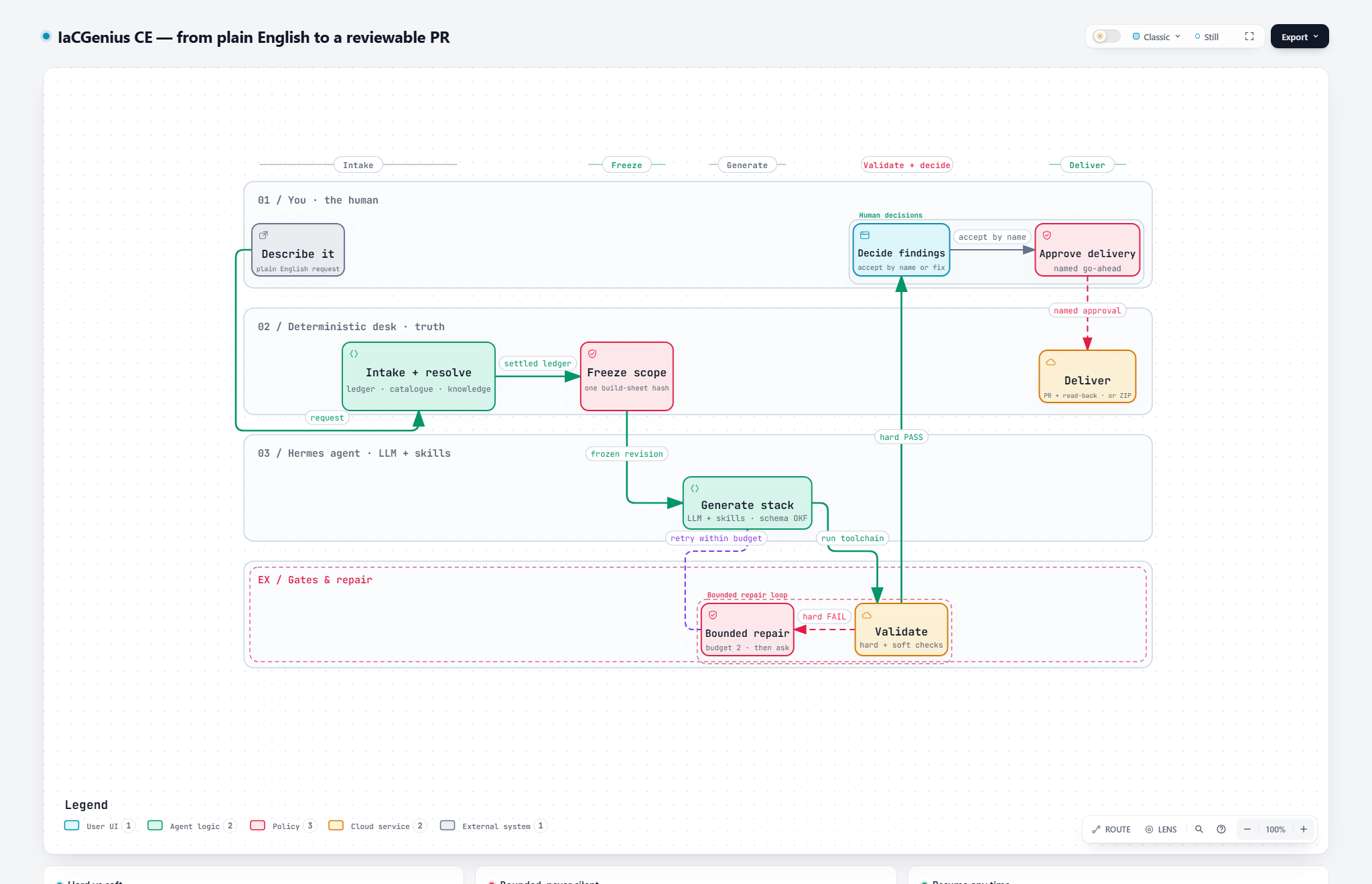
terraform validate and the secret scan are hard gates — they must pass. tflint, checkov and fmt are soft choices you accept by name or fix. A scanner that did not run is NOT_RUN, never PASS.
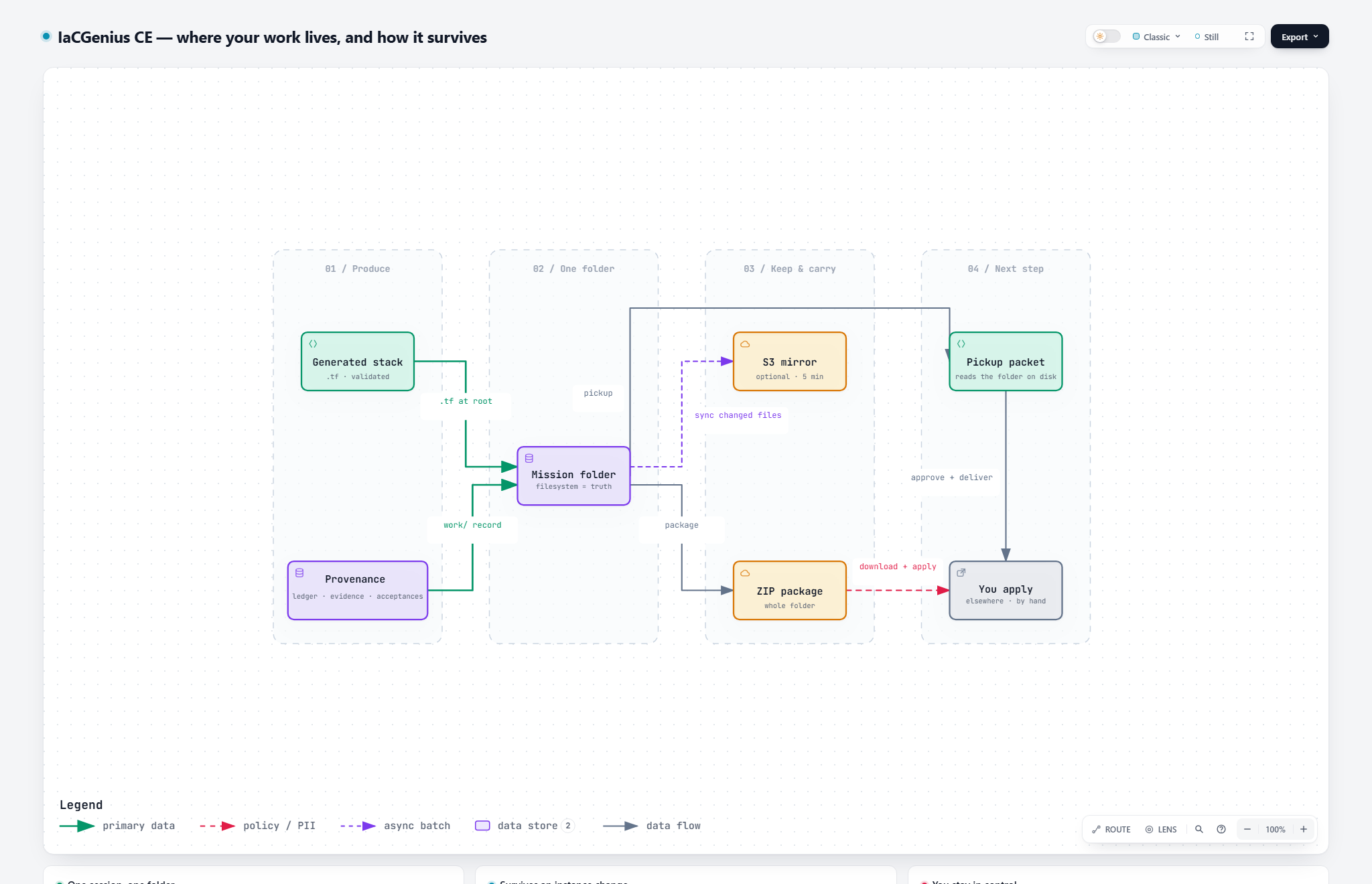
One mission, one folder: the .tf code plus a work/ record of what was decided and who decided it. The filesystem is the source of truth; a lost folder is forgotten, not a stale database row.
A pinned Hermes container holds the agent, its skills and the IaCGenius plugin — no cloud credentials, never applies. The deterministic service runs credential-less on the host. External capability comes from the Hermes ecosystem's MCPs, not re-implemented code. Every box in the diagram cites the source that proves it.
Three surfaces: Chat to talk to IaCGenius, the mission board to watch progress, and Files to read and download the code. These are real screenshots from a running installation.
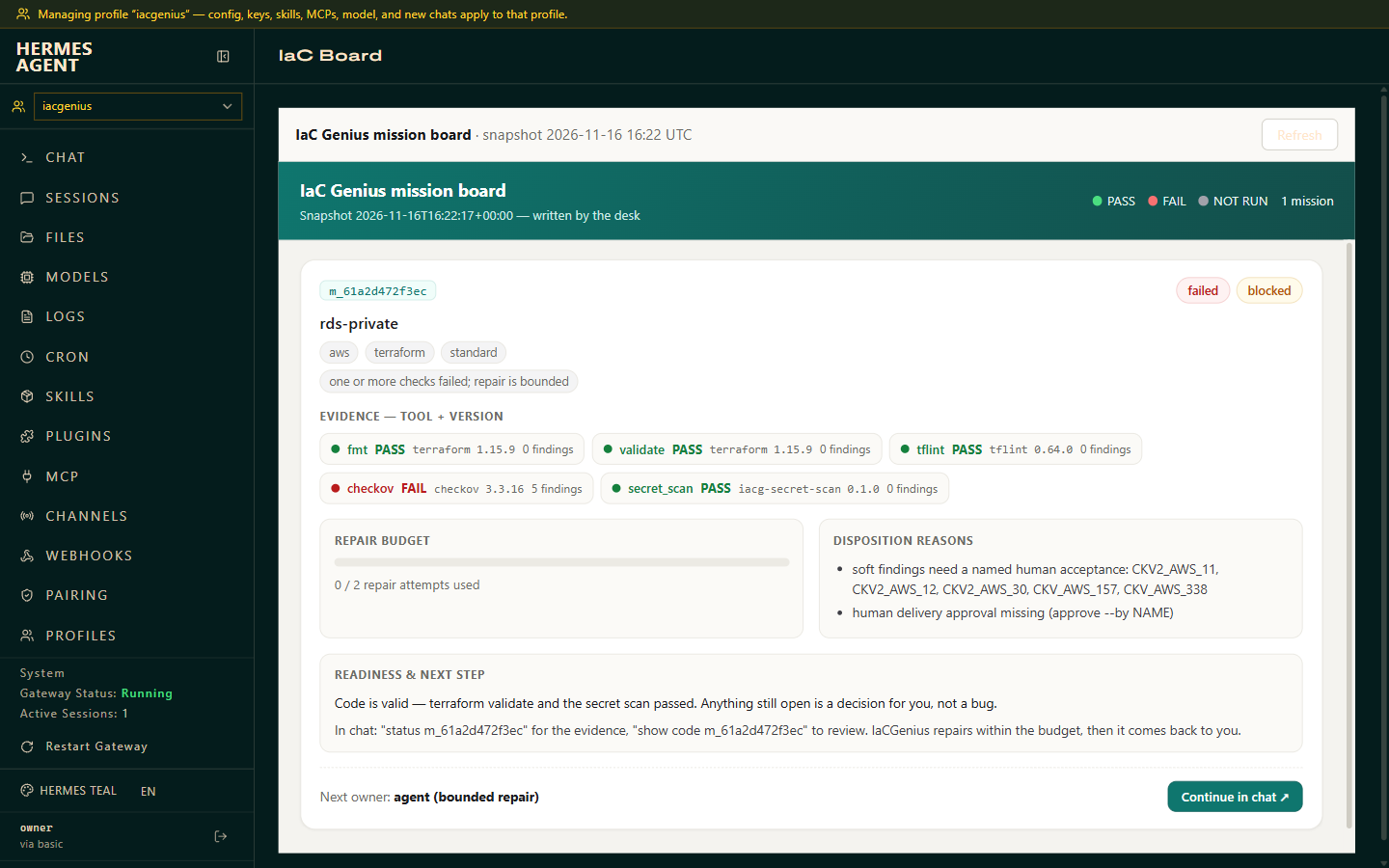
The mission board
Evidence chips with the tool and version behind every check, the repair budget, exactly what is still open, and a plain-language next step. A card can say “failed” while the code is valid — that means a decision is pending, not that the Terraform is wrong.
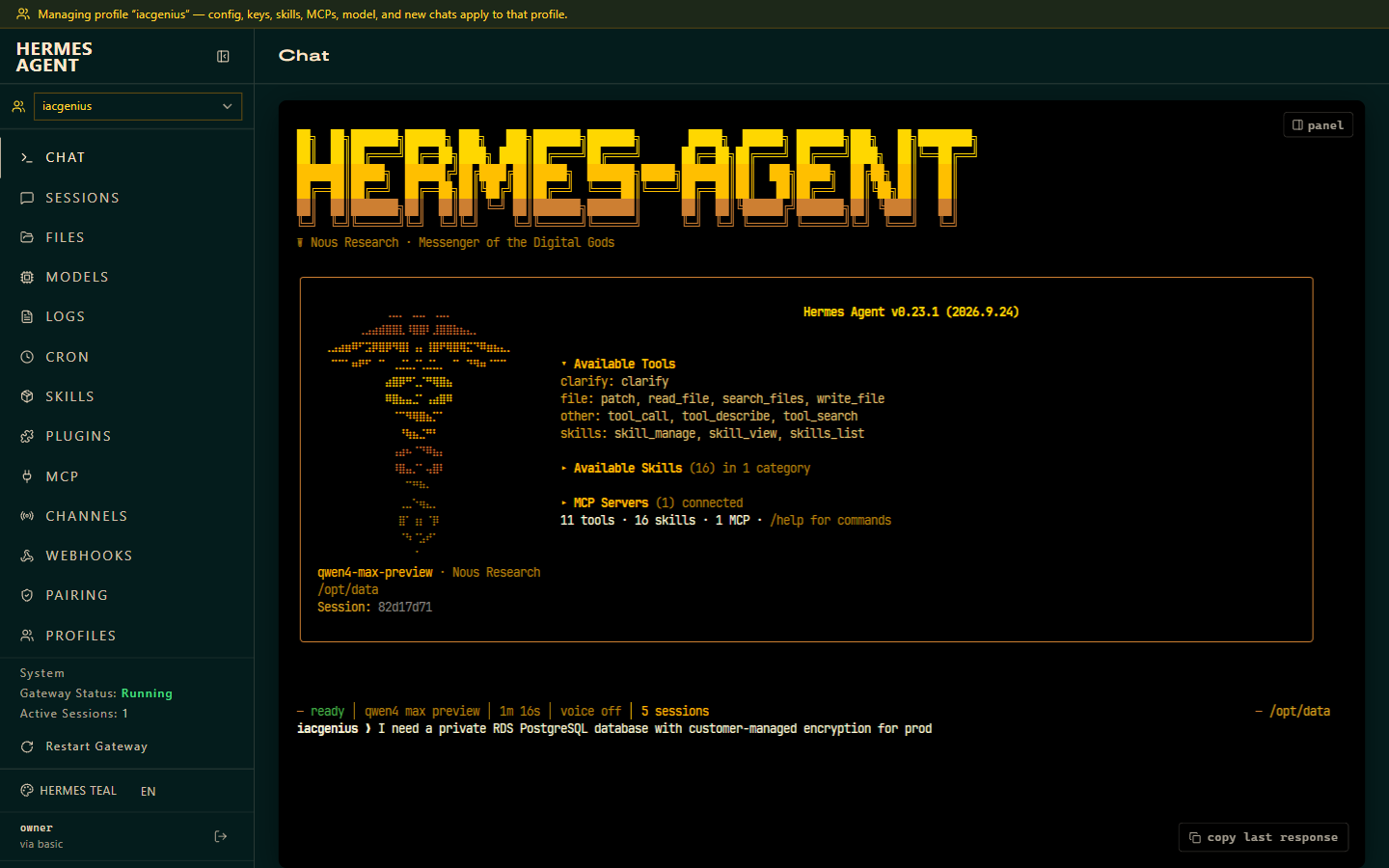
Ask in plain English
The pinned Hermes agent, ready with its skills and the ecosystem MCP loaded. Type the request; intake settles the rest from your conventions.
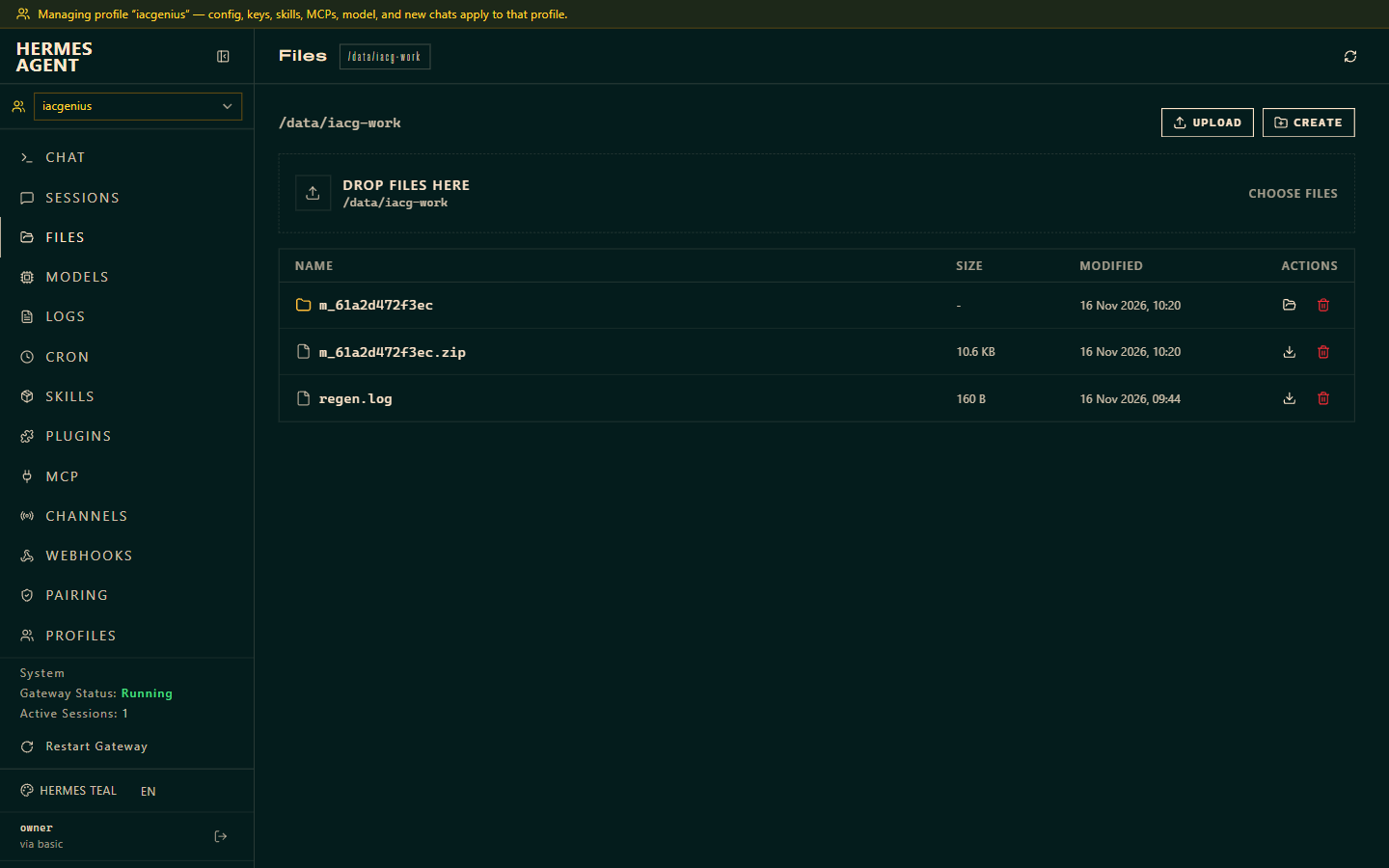
One folder, one ZIP
The mission folder and its single ZIP download in the Files tab — explore it offline, apply it wherever you like.
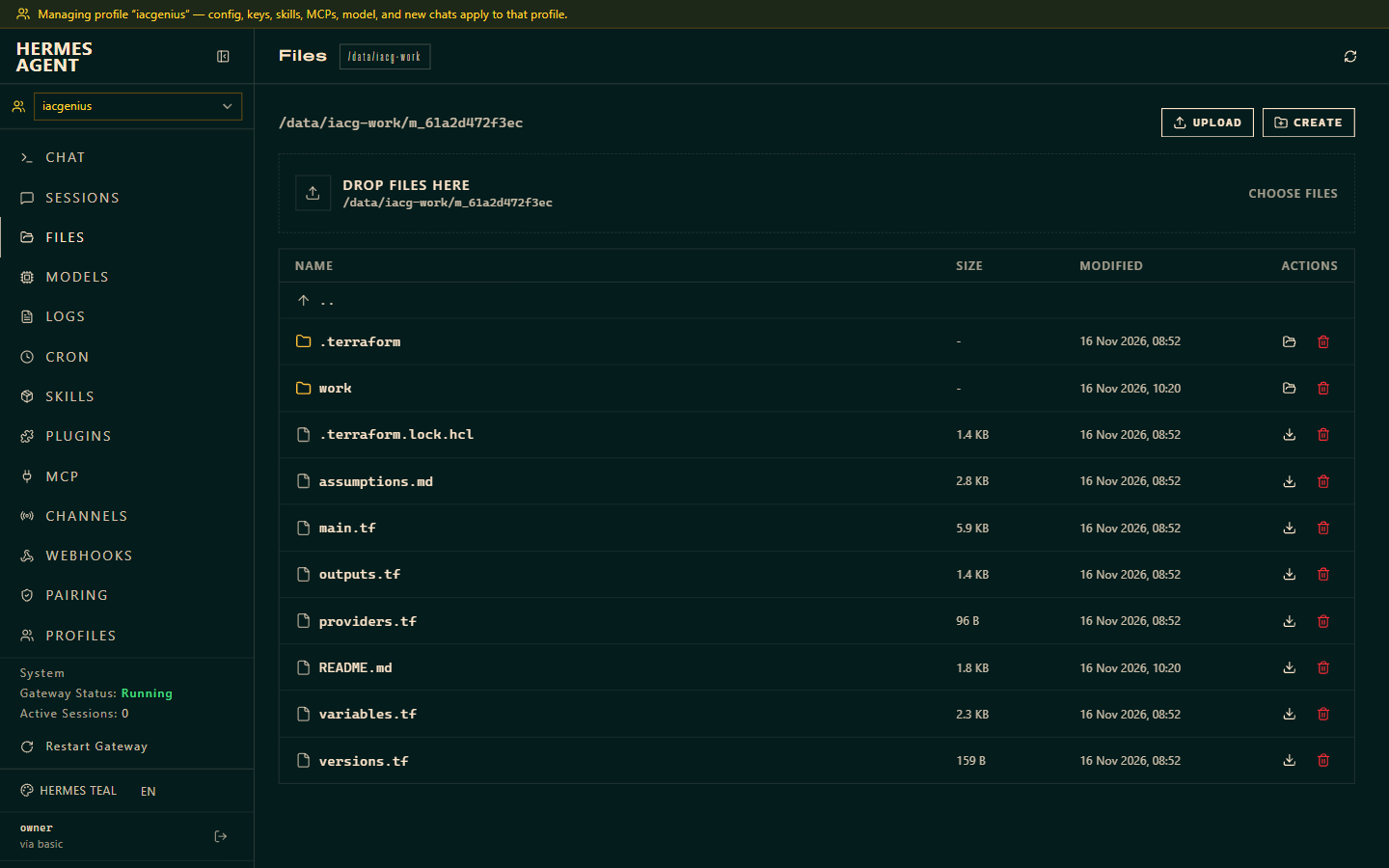
Code and provenance, separated
The .tf stack at the root; a work/ folder keeps what was finalized and who did what.
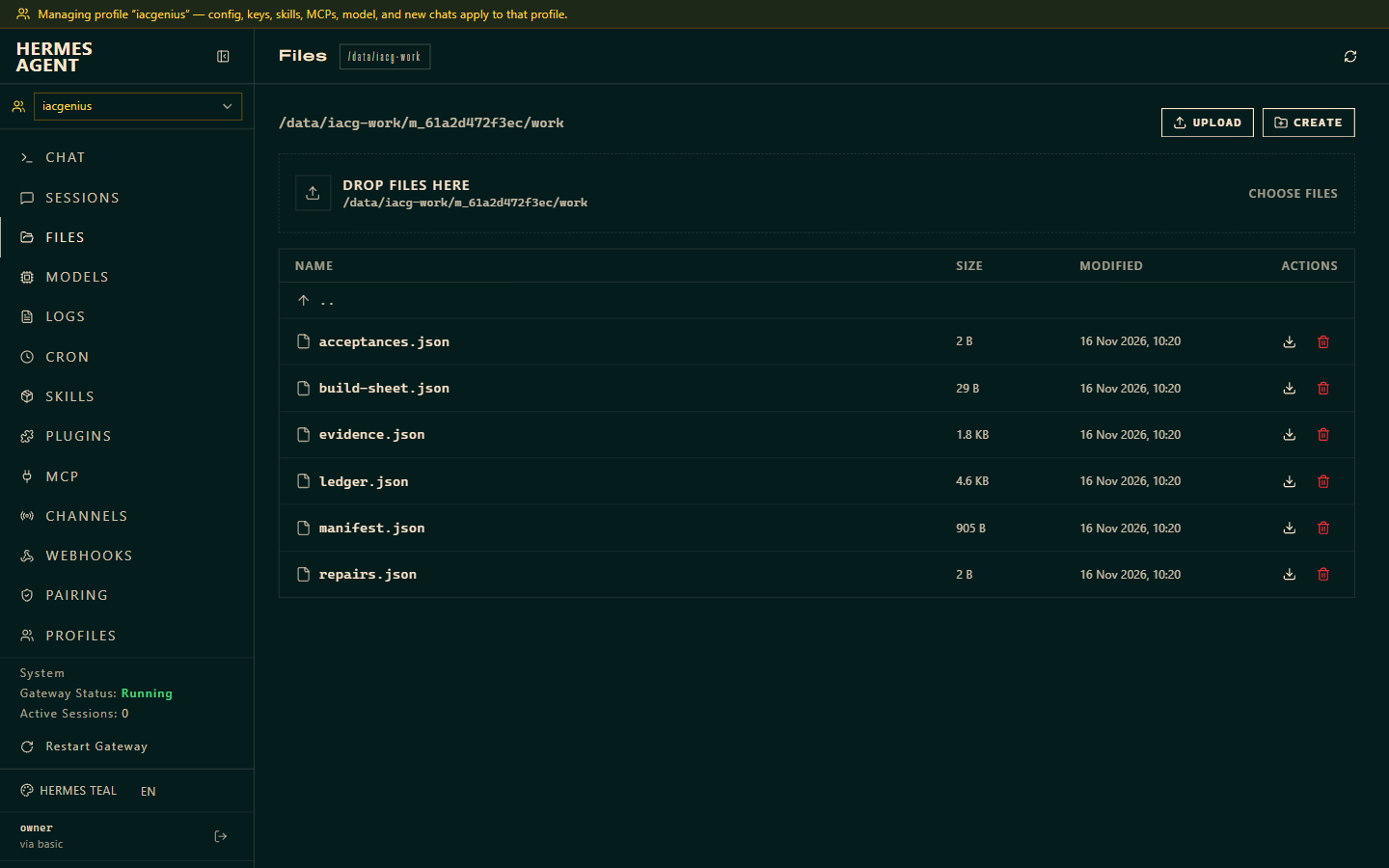
The work/ record
ledger · build-sheet · evidence · acceptances · repairs · manifest — the durable handoff a later session reads to resume.
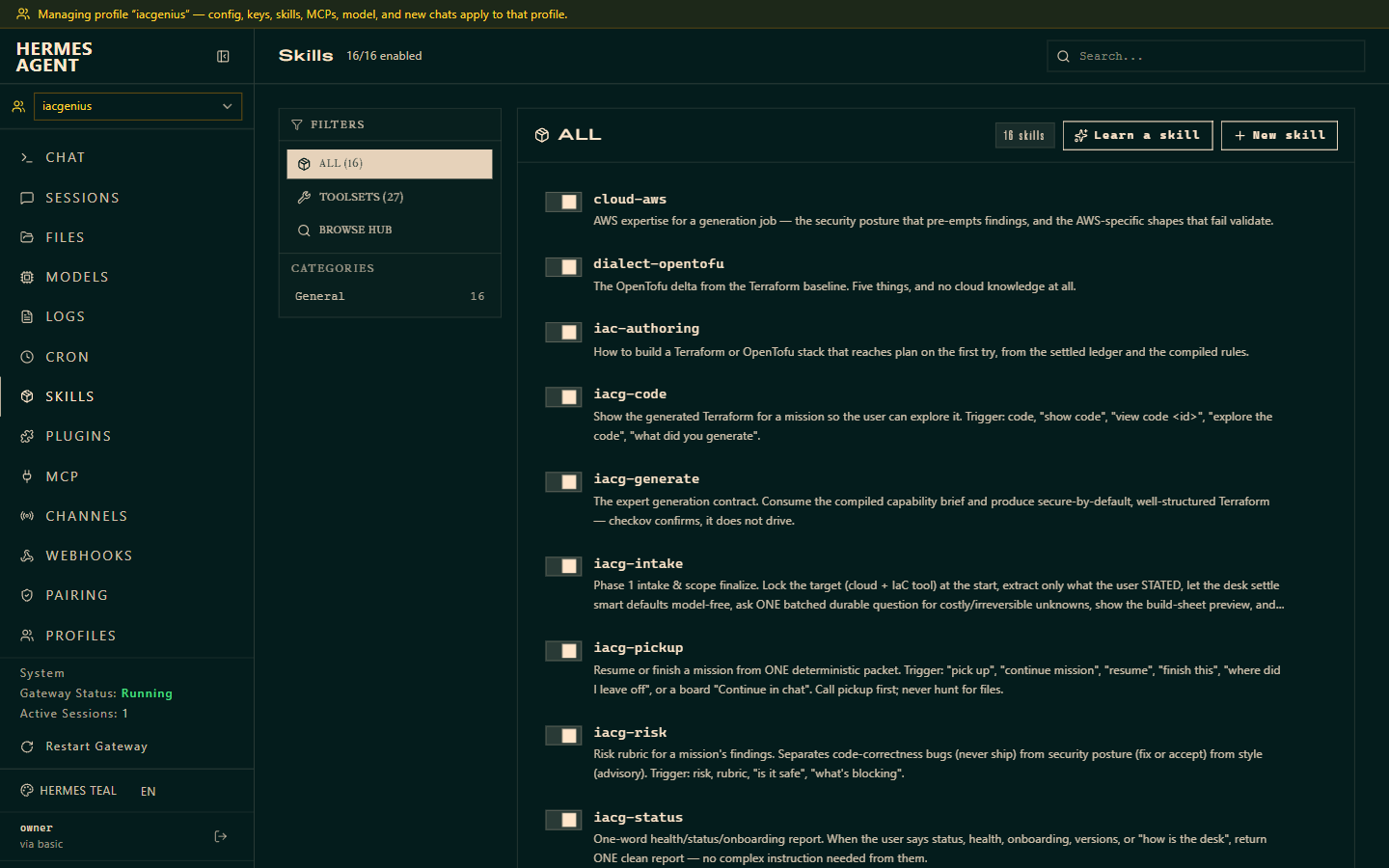
A registry of skills
Intake, generate, pickup, risk, status and wrapup, plus cloud and IaC craft skills — each one inspectable.
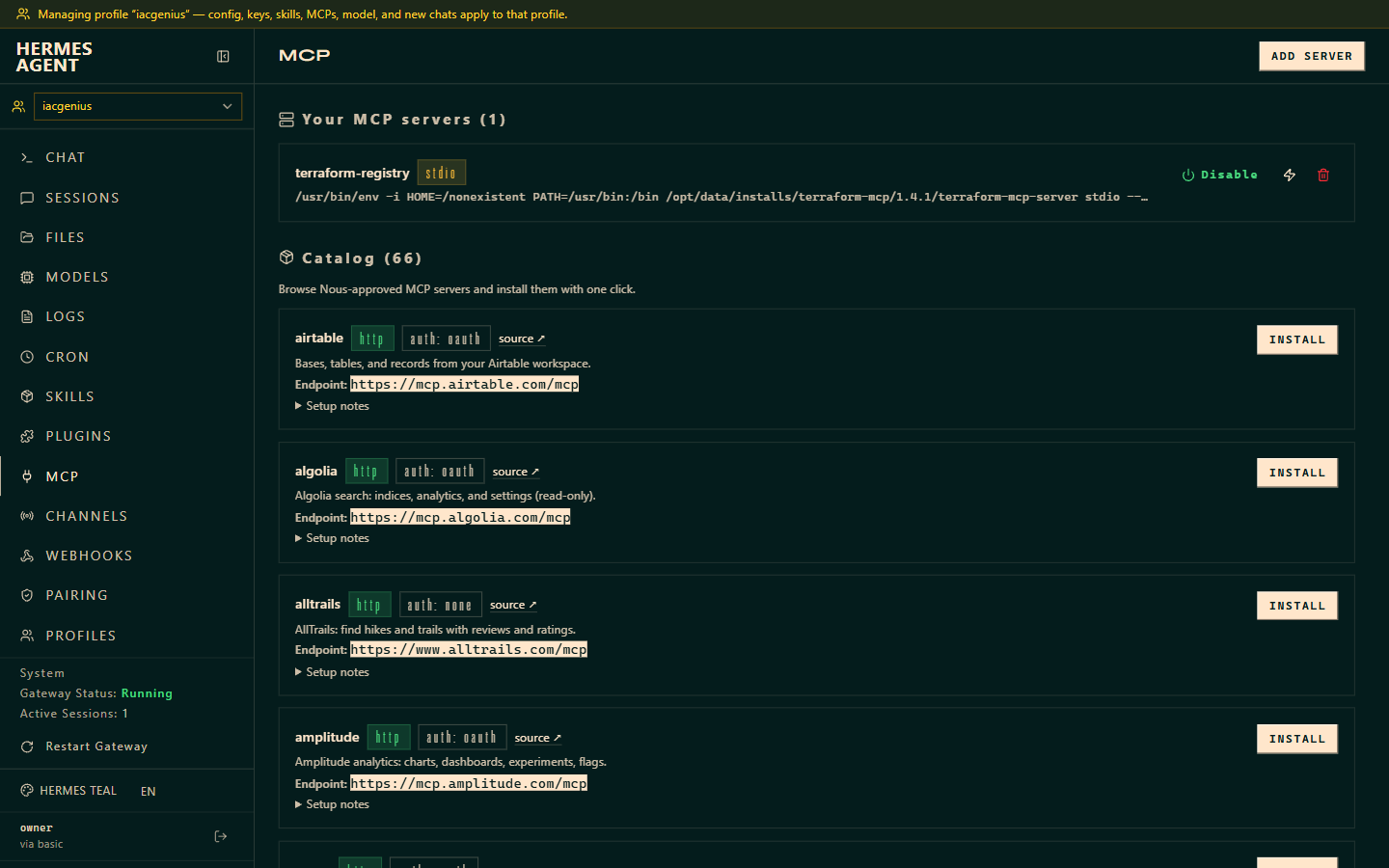
Consume the ecosystem
The connected terraform-registry MCP, and a catalog of Nous-approved servers one click away. We guide, detect and consume — we do not rebuild.
Intake asks only the costly or irreversible questions, freezes the scope into one hash, generates schema-grounded code, then validates. Hard failures trigger a bounded repair loop; soft findings come to you. Delivery needs a named human approval.
A real mission — m_61a2d472f3ec, “a private RDS PostgreSQL database with customer-managed encryption for prod.” Here is exactly what IaCGenius recorded.
| Check | Tool · version | Result | Kind |
|---|---|---|---|
| validate | terraform 1.15.9 | PASS | hard gate |
| secret_scan | iacg-secret-scan 0.1.0 | PASS | hard gate |
| tflint | tflint 0.64.0 | PASS | soft |
| fmt | terraform 1.15.9 | PASS | soft |
| checkov | checkov 3.3.16 | FAIL · 5 | soft · your call |
The settled ledger chose single-zone availability, so Multi-AZ (CKV_AWS_157) is a human accept-or-revise decision — the generated code says so in a comment rather than silently flipping it.
The owner tag platform-team was declared once as a knowledge card. The generated stack carries it straight into the tags — no re-asking:
locals {
  common_tags = {
    Project     = "iacg-rds-private"
    Environment = "prod"
    ManagedBy   = "iacg-ce"
    Owner       = "platform-team"   # from a knowledge card
  }
}
And the code is sound: a customer-managed KMS key with a scoped policy, private subnets, a VPC-only security group, deletion protection, and a managed master password — never a literal secret.
The folder is the truth. An optional incremental S3 sync mirrors only changed files every 5 minutes and restores on boot — so a replacement instance picks up where the last one left off. pickup returns one packet to resume; package zips the folder to carry it.
One instance, a pinned Hermes image, your model key. The full Terraform and a screenshot-driven guide are in the repository.
One EC2 instance, a private S3 bucket, SSM-only access. First boot pulls a pinned Hermes image and installs the toolchain. Prefer a persistent instance; an optional S3 sync makes Spot survivable.
SSM port-forward to the dashboard and sign in. Ask IaCGenius to onboard once to warm the shared provider cache — no per-mission downloads.
“A private RDS PostgreSQL database with customer-managed encryption for prod.” Answer the few costly questions; the rest resolves from your remembered conventions.
Accept soft findings by name, approve delivery, then open a pull request (read back to confirm) or package a ZIP. You apply it yourself, elsewhere.
Early build (0.1.0). It proposes validated code and a reviewable PR; it does not apply infrastructure. You run it on your own instance and review every diff before applying. Applying is always yours to do, elsewhere.
IaCGenius CE is the tool we use and share. If you would rather a senior cloud engineer build your whole foundation — multi-account, SSO, guardrails, audit logging, encryption — and hand it over as Terraform you own, that is our consulting practice.